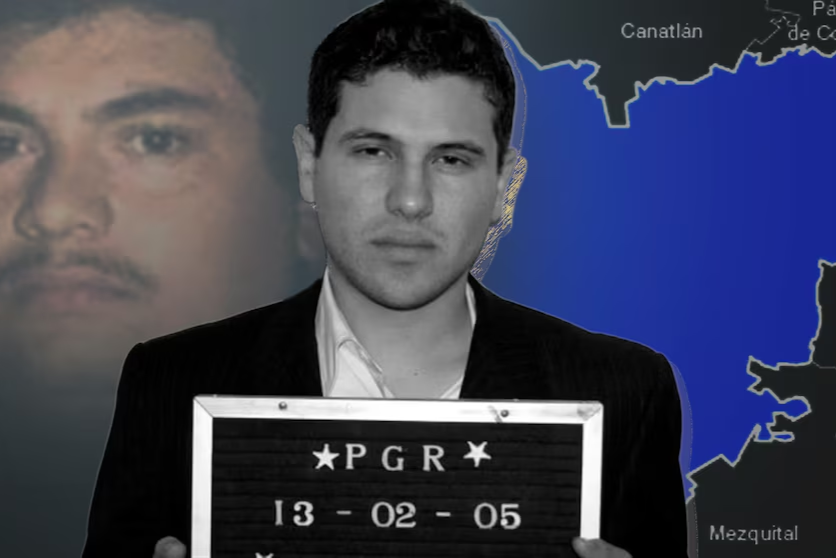

The operation in Durango that culminated in the arrest of the right-hand man and head of security for Aureliano Guzmán Loera, known as “El Guano,” brother of Joaquín “El Chapo” Guzmán, is believed to be connected to the discovery in Chihuahua of the largest drug lab in the country, in which CIA agents participated.
Although the two events appear unrelated, journalist Jesús Lemus Barajas explained in an interview with Infobae Mexico that it was a massive operation deployed with the intention of capturing Iván Archivaldo Guzmán Salazar, after agents from both the CIA and the DEA obtained a location they believed belonged to “El Chapo’s” son.
According to the journalist, who focuses on drug trafficking, the operation began after the capture of Nemesio Oseguera Cervantes, alias “El Mencho,” when agents obtained the location of a phone they believed belonged to Iván Archivaldo in Badiraguato, Sinaloa.
After tracking the device for several days, the same device revealed a second location near Guachochi, prompting an operational deployment in Chihuahua from Ciudad Juárez.
Upon arriving at that location, U.S. agents and Mexican Army personnel reportedly located the drug lab. After dismantling it, they were attacked by gunmen working for “El Guano.”
Lemus Barajas stated that the confrontation took place in the community of Polanco, as the agents were withdrawing from the drug lab, and that the two CIA agents were allegedly attacked with a rocket launcher, resulting in their deaths.
It should be noted that the accounts provided by the Chihuahua Attorney General were contradictory. Initially, the participation of two U.S. agents was reported (later it was stated that there were four). César Jáuregui Moreno asserted that the agents had requested to be transferred to the state capital after encountering the convoys in the town, but that they had not participated in the discovery.
The official version states that the vehicle in which the two CIA agents died (along with the director of the State Investigation Agency [AEI], Pedro Román Oseguera Cervantes, and his bodyguard) was involved in a car accident on a dirt road and caught fire after collapsing.
Jesús Lemus indicated that, after the confrontation, the agents moved toward Durango because the tracking device indicated a new location in El Durazno, so they traveled to that state.
“The operation was reorganized, and as far as we know, ‘El Guano,’ along with the people who were operating the lab, headed toward El Durazno. Then the United States government reported that the tracking device was being moved, and they located it in El Durazno. That’s where the second confrontation took place, resulting in Aureliano’s capture,” he commented.
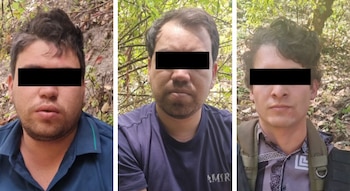
According to the journalist, the operation in Durango not only resulted in the arrest of 10 people on April 23, including Etzar Lugo “N,” head of security for “El Guano,” and Abel “N,” his right-hand man, but also reportedly led to the arrest of Aureliano Guzmán Loera.
“Aureliano was among them. When the president learned he was detained, that’s when the secrecy began. Everyone knew ‘El Guano’ was arrested because information started leaking to prevent his release,” he stated.
It should be noted that, initially, security sources confirmed to Infobae Mexico that “El Guano” was detained following the operation in Tamazula; however, this version changed minutes later.
The fall of Aureliano Guzmán’s security detail would be one of the irregularities in the operation pointed out by Lemus Barajas, since a criminal leader’s inner circle cannot be in any other location than the leader himself, at any time. This lends credence to the journalist’s hypothesis that “El Guano” was released.
Regarding the Chihuahua Attorney General’s statements that the two deceased CIA agents had only asked the State Attorney General’s Office officers for a ride, Lemus Barajas explained that it was an unplanned damage control measure that only demonstrated a lack of coordination with Mayor Claudia Sheinbaum Pardo.
The journalist also noted that the involvement of U.S. agents is not new, as collaboration already exists in states such as Michoacán, Jalisco, the State of Mexico, and Sonora, among others, which federal authorities are aware of.
Source: infobae