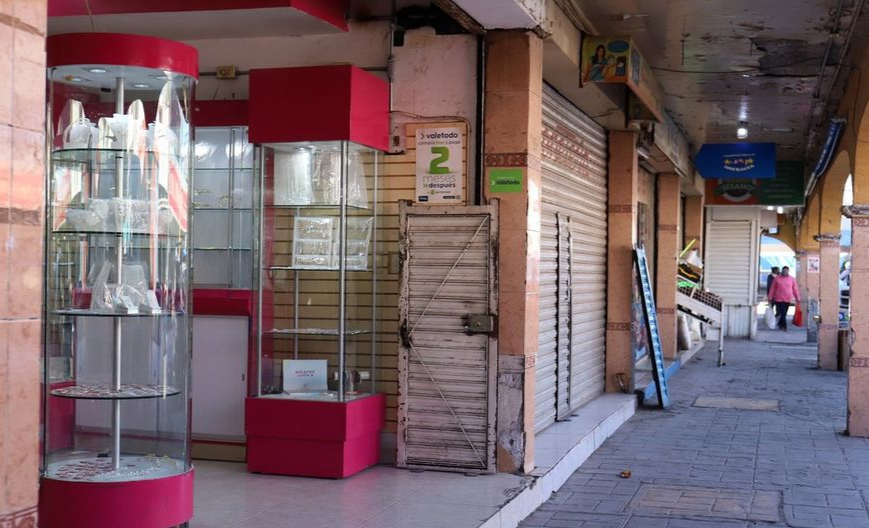

Opening or maintaining a business in Durango City has become a test of endurance with very little chance of success.
What was once an attractive location for local investment now faces an overwhelming reality: disproportionately high rental costs, tax and employer obligations that consume up to 30% of business income, a stagnant national economy, and the gradual decline of the city’s main commercial hub: the Historic Center.
Historically, the city’s downtown area represented the safest investment for traditional commerce due to its high pedestrian and tourist traffic. However, in recent years, Durango’s Historic Center has gone from being the local economic engine to becoming one of the factors that most increases costs and complicates entrepreneurship.
The situation began with a real estate bubble driven by the massive arrival of businesses backed by Chinese capital. These establishments rented commercial spaces at prices far above their actual market value.
Although federal government operations significantly reduced the presence of these low-cost retail businesses, the aftermath remained: property owners kept rental prices extremely high, refusing to adjust them to the economic reality faced by local merchants.
This has been compounded by the gradual deterioration of downtown infrastructure, parking problems, and changing consumer habits as shoppers increasingly move toward newer commercial districts or digital platforms.
The result is evident throughout the area: dozens of vacant storefronts display “For Rent” signs. These are not only large commercial spaces but also small shops that housed family-owned businesses for decades and now remain shuttered.
Even along the city’s busiest boulevards, where urban expansion has taken place, business conditions have failed to generate the expected sales, leaving merchants with no viable relocation alternative.

Durango Business Owners Say High Rents, Taxes, and the Economic Slowdown Are Hurting Profitability
A Tax and Employer Burden That Consumes Up to 30% of Revenue
For those who manage to afford the cost of a physical location, the next obstacle is taxation and labor-related expenses. Sergio Sánchez, President of the National Chamber of Commerce (Canaco), explained that taxes, employer obligations, and increased employee benefits now consume as much as 30% of business income.
“Employer contributions, Social Security (IMSS), Infonavit, and every employee benefit now impact us twice as much as they did in previous years. Increases to the minimum wage and longer vacation periods have forced us to drastically reduce our profit margins or cut costs simply to avoid going out of business.”
Meanwhile, Karen Rivas, President of the Young Entrepreneurs Council (CEJ), agreed that operating a physical business in Durango has become financially unsustainable.
She explained that, due to insufficient daily sales, entrepreneurs first exhaust their personal savings and then turn to loans to cover payroll and rent until the business model eventually collapses.
Rivas added that very few businesses are currently able to generate real profits.
“Month after month, most businesses operate at a loss. For those who manage to earn a profit, simply generating positive earnings is already a victory. However, under the law they must still comply with mandatory profit-sharing, which further reduces their ability to reinvest.”

Growth on Unstable Ground and External Factors
The broader economic outlook offers little relief. Arnoldo Gutiérrez Nevárez, Vice President of Financial Affairs at Canaco, warned that both the local and national economies remain stagnant.
Forecasts for the end of 2026 estimate economic growth of only 0.5% to 1.0% for Durango, while national growth is also expected to remain below 1%.
Gutiérrez Nevárez pointed out that the local economy has been severely affected in several key sectors.
a) Closed Borders and the Livestock Crisis
The presence of the New World screwworm and border restrictions with the United States have slowed cattle exports, significantly affecting Durango, the country’s second-largest beef-producing state.
b) Trade and Legal Uncertainty
The annual review of the United States–Mexico–Canada Agreement (USMCA) has failed to produce the expected results for Mexico.
In addition, the private sector remains concerned about legal uncertainty generated by the election of judges through popular vote, which businesses believe discourages new investment.
c) The Only Bright Spot: Mining
Mining has remained the state’s only resilient sector, largely driven by high international metal prices.

Real Estate Market Forced to Adjust
Against this backdrop, Oliver Morales, leader of merchants in Durango’s Historic Center, stated that the economic downturn has lasted for at least three consecutive years, reducing businesses’ ability to reinvest or reinvent themselves.
Reflecting the growing number of vacant commercial properties, Alicia Domínguez, President of the Mexican Association of Real Estate Professionals (AMPI), Durango Chapter, explained that property owners have recently begun lowering rental prices because they are no longer able to find tenants willing to pay the rates that were common in previous years.
As rental prices slowly begin to stabilize out of necessity, local business owners continue struggling with debt, taxes, and declining sales in a city where entrepreneurship has become less a life project and more an act of survival.

Source: milenio